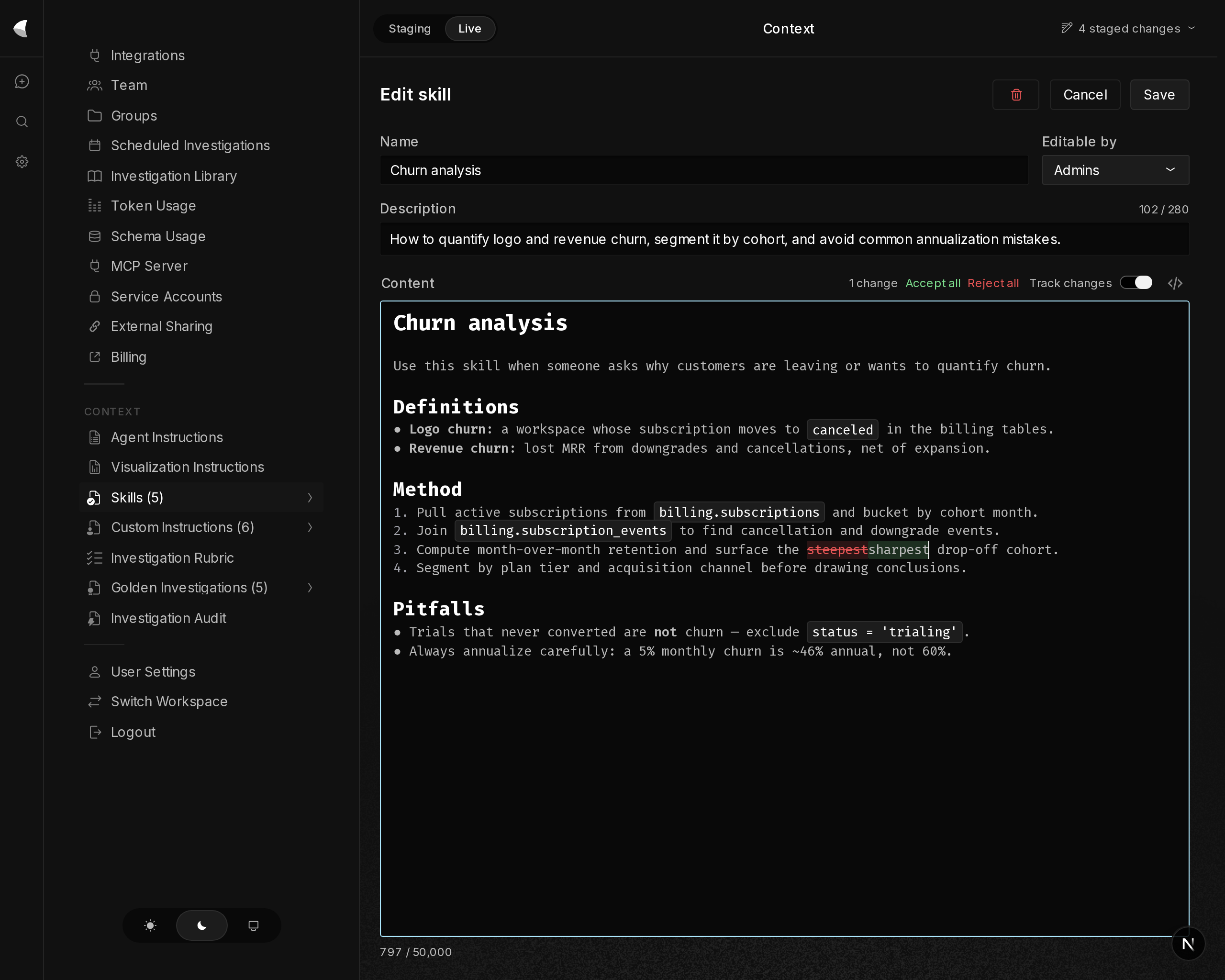
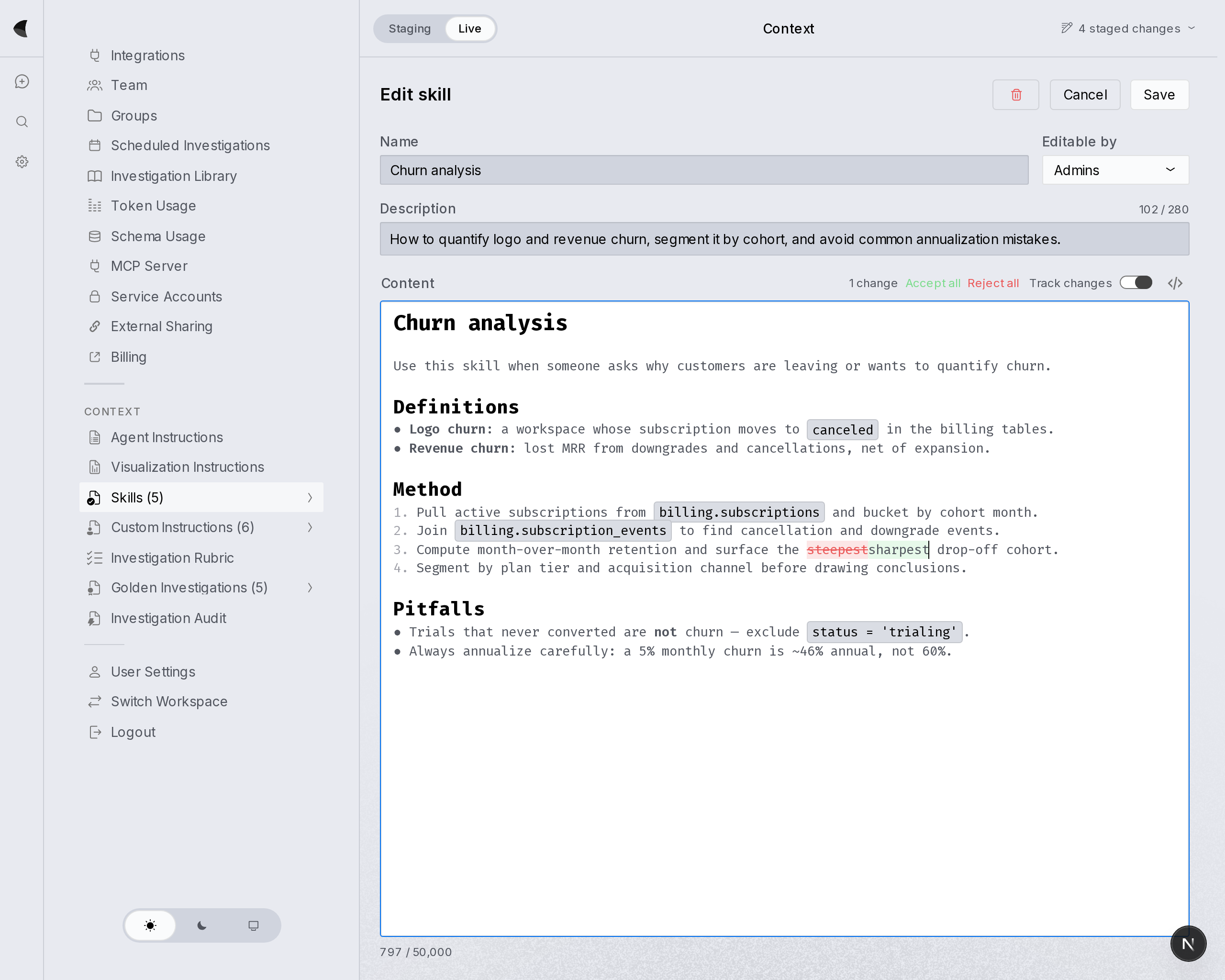
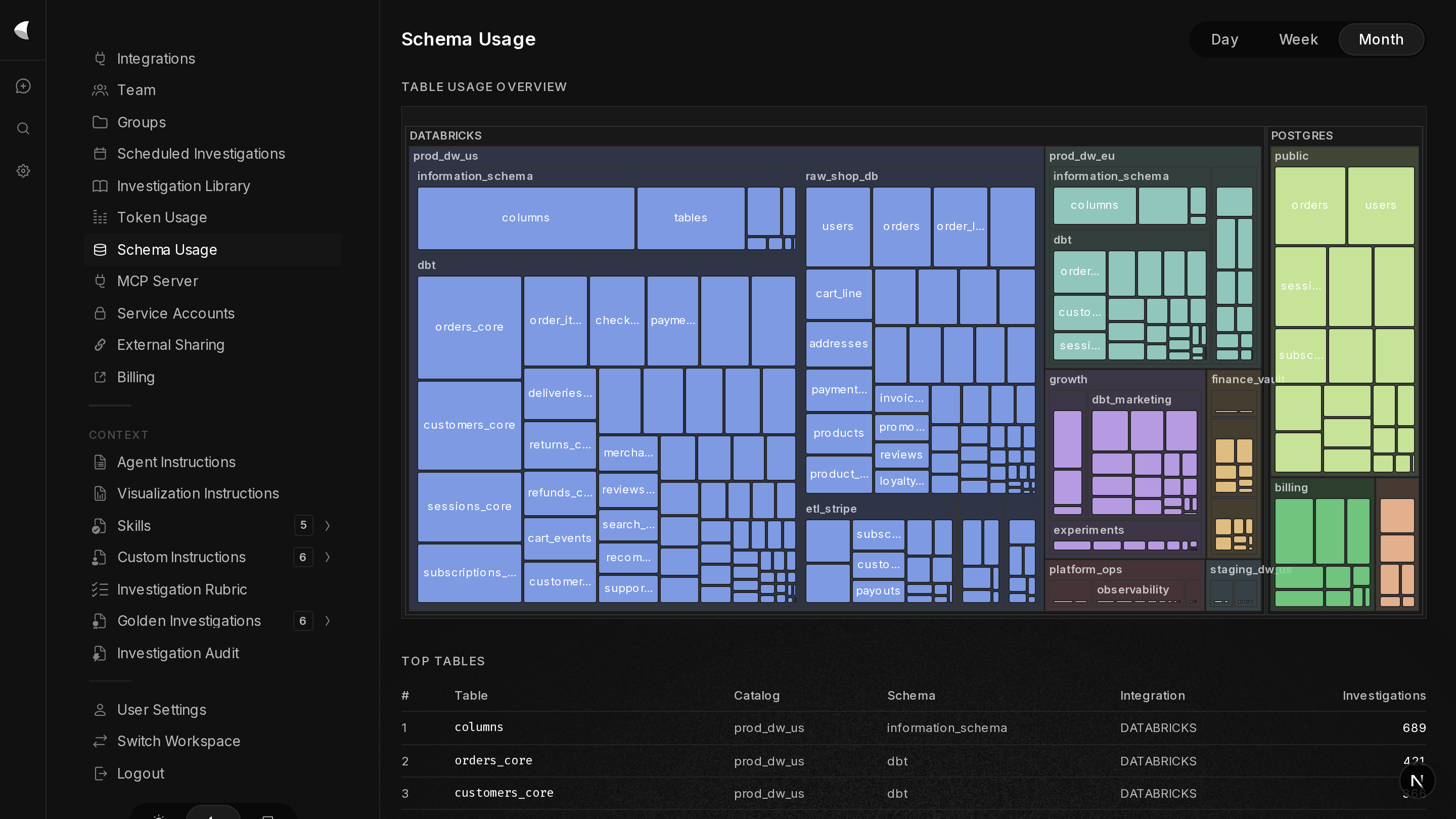
- Klaviyo integrationConnect Klaviyo to analyze your email and SMS campaigns, flows, lists, segments and conversions.
- Gorgias integrationAdd your Gorgias helpdesk to investigate support tickets, customer satisfaction surveys and support team metrics.
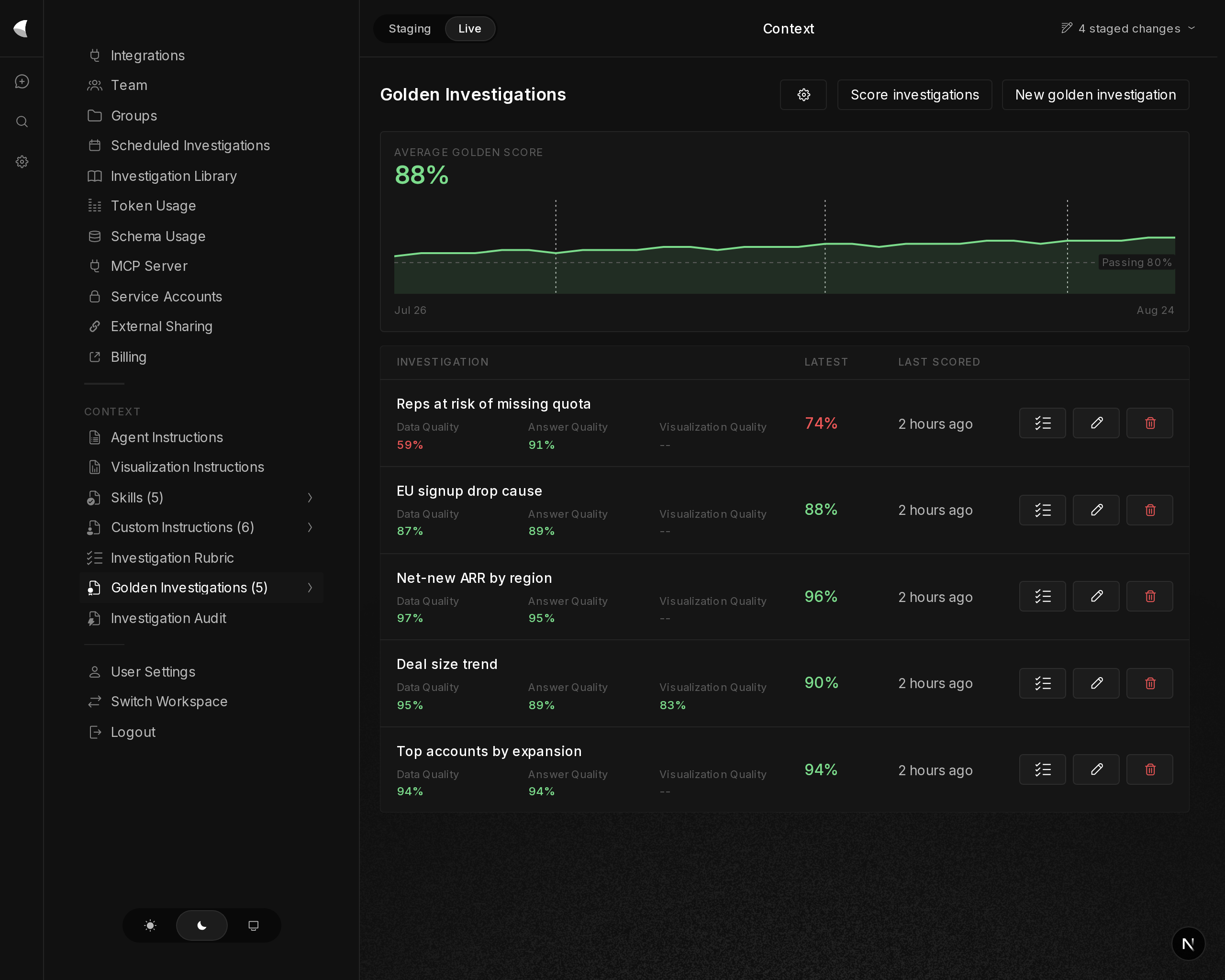
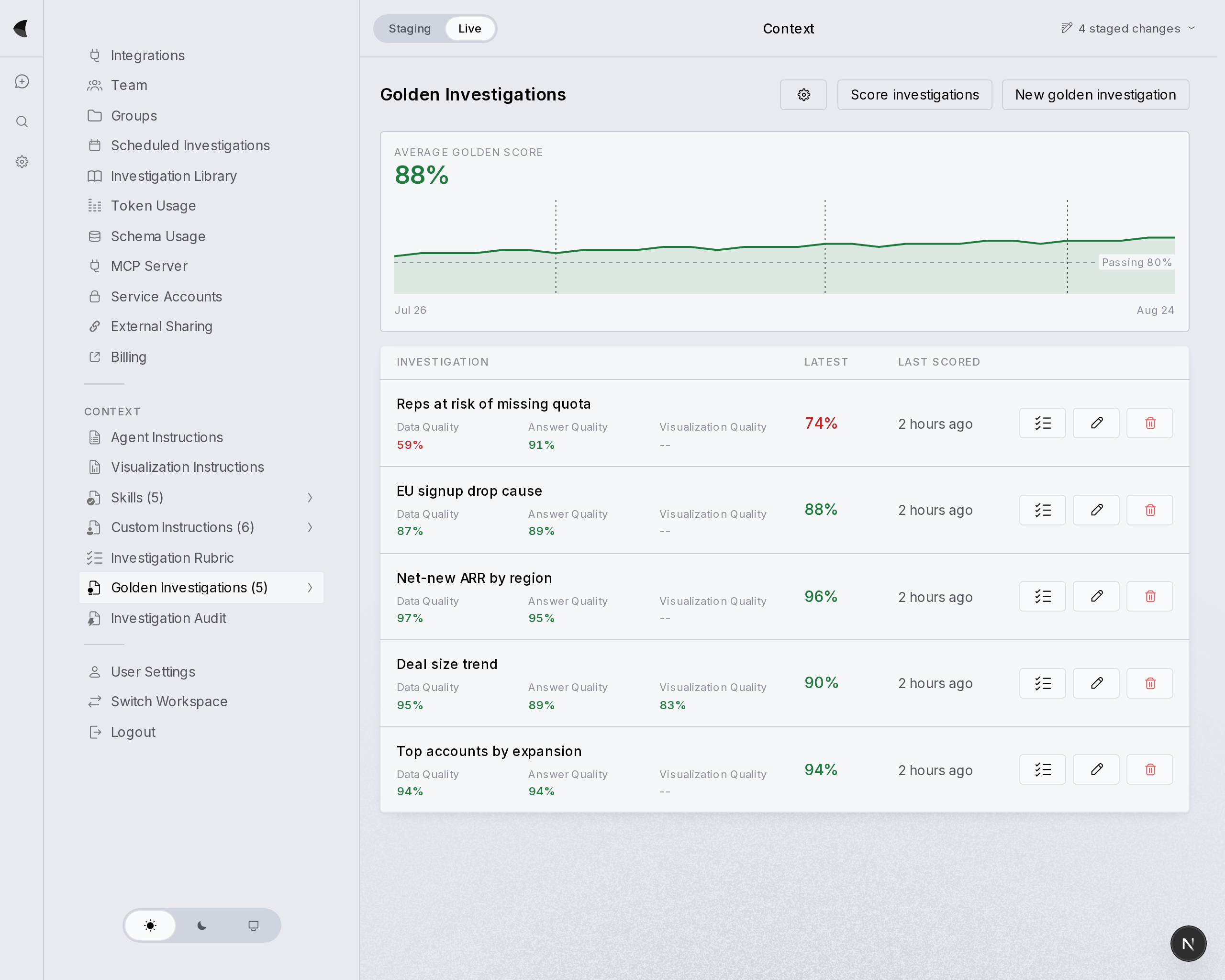
- Animated chartsCharts in investigations and reports now animate in the first time they appear. Dashboard cells fade in in a diagonal wave, and table rows cascade in.
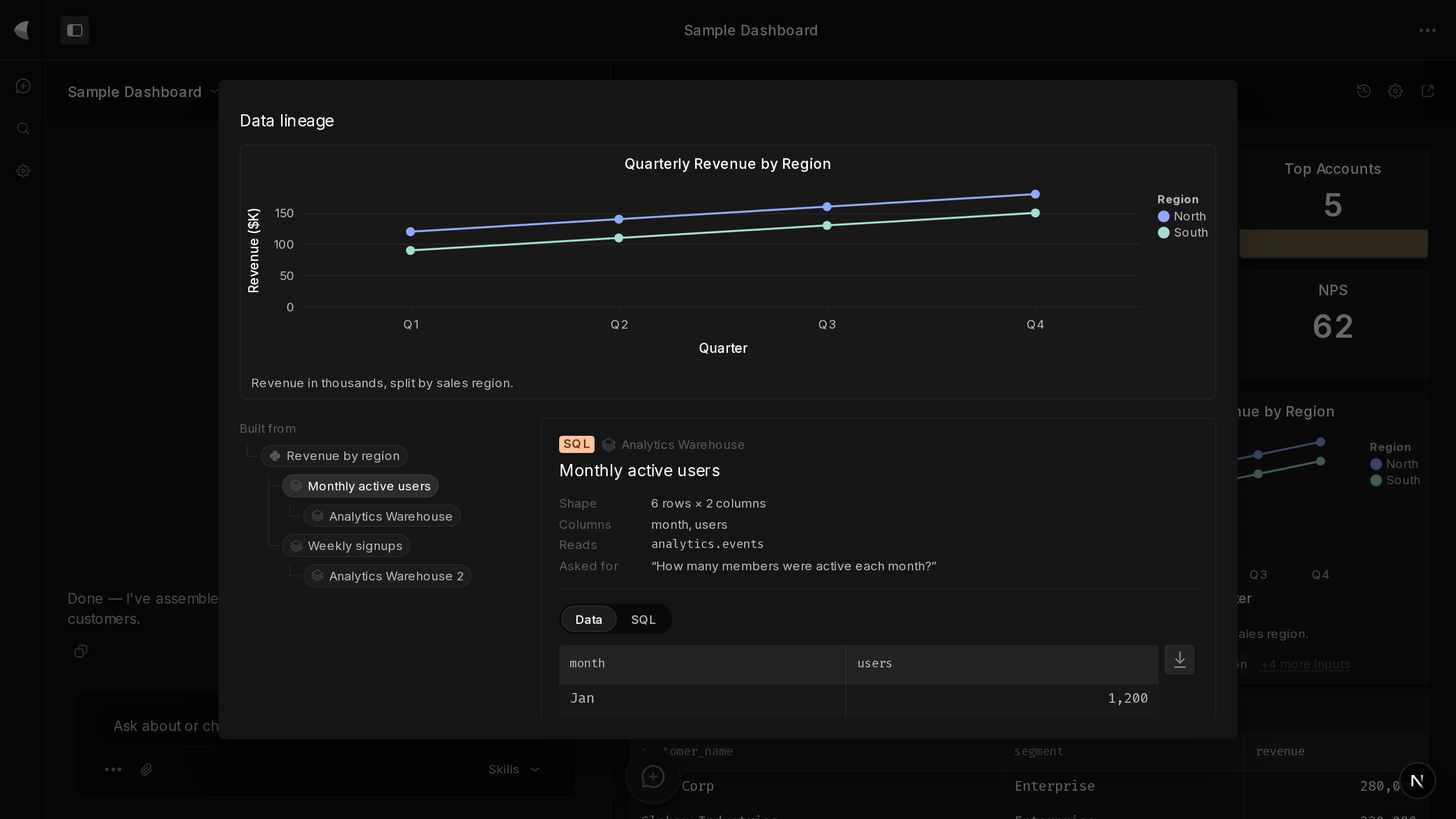
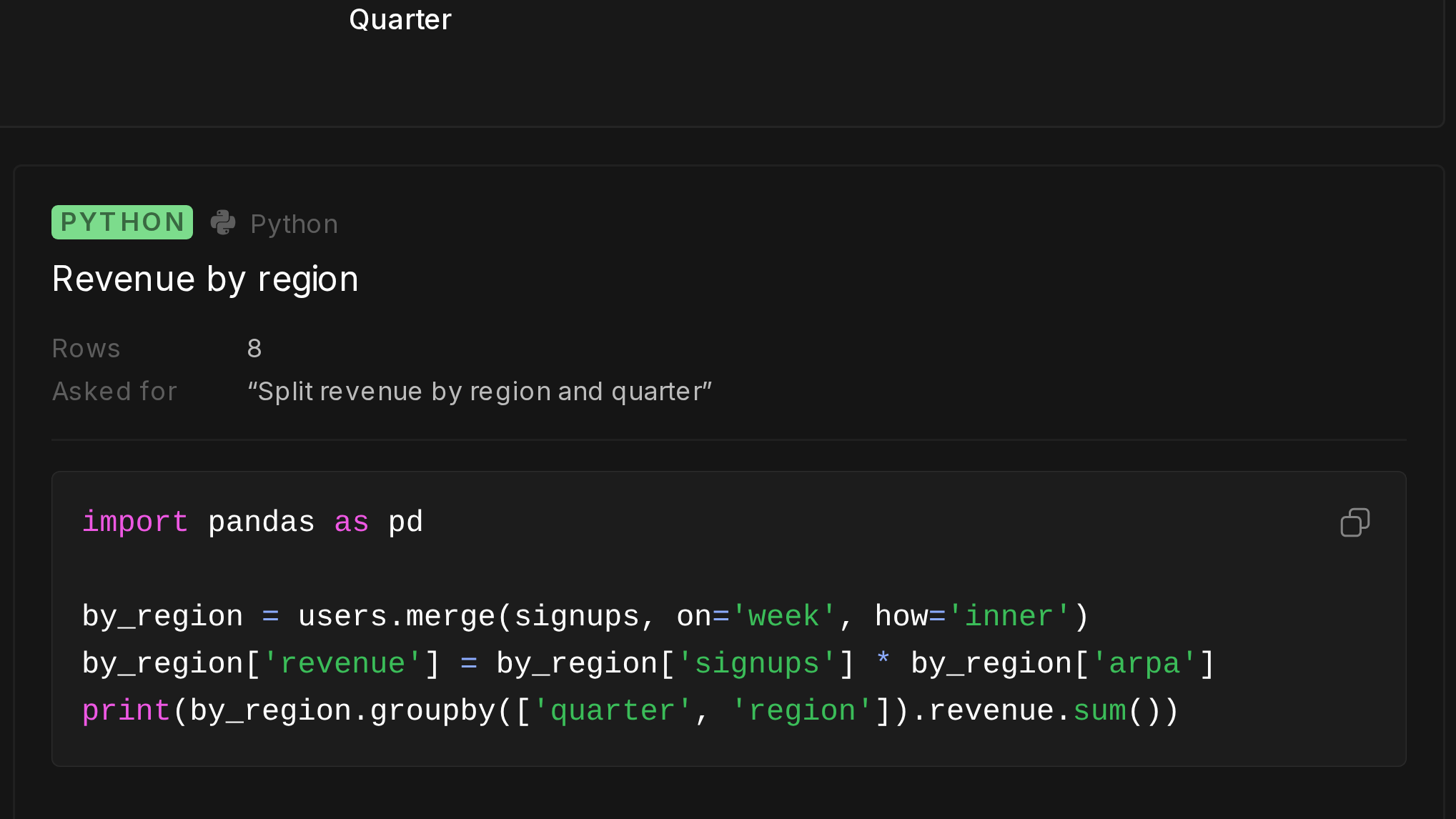
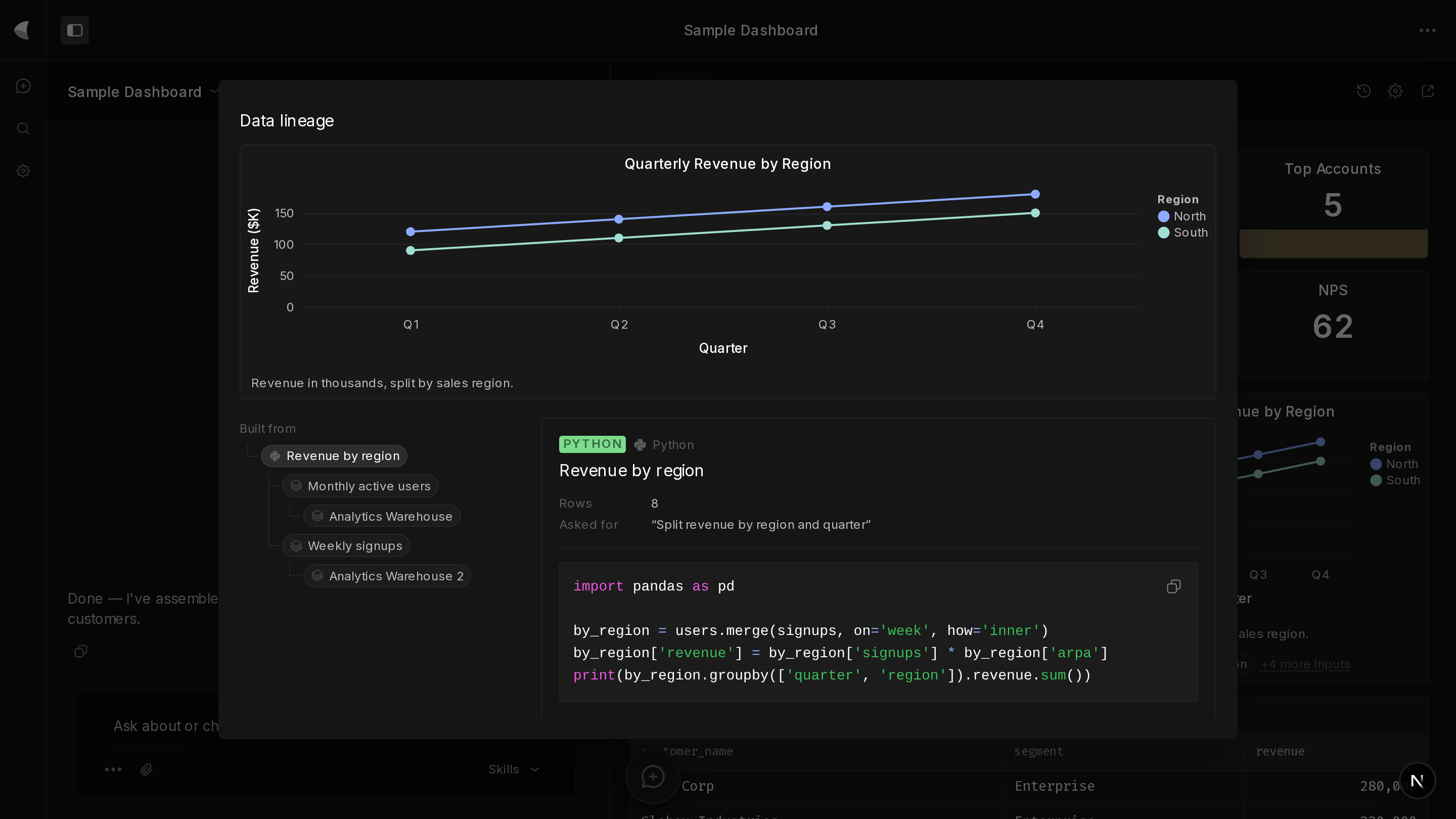
- Redesigned data lineageThe data lineage view on tables, charts and diagrams is now more colorful and easier to understand.
- When too many reports and dashboards are refreshing at once, new refreshes now queue and start automatically, instead of piling on.
- Long code blocks in investigations now collapse after 20 lines with a "Show more" footer, and SQL and Python get syntax highlighting as they stream.
- Python code now shows the names of the datasets it reads, rather than internal IDs.
- Charts and diagrams now show their name above the loading spinner.
- Dashboard tables scroll within their cell, with a sticky header.
- Switching to a different report or dashboard now scrolls it back to the top.
- Split the "Marketing, Sales & Finance" integration group into "Marketing," "Sales & Support" and "Revenue & Finance."
- Redesigned the workspace invite to show who invited you.
- Python starts about 35% faster.
- Token usage and message CSV exports are faster.
- The chart agent spends fewer turns trying to fix axis labels that weren't actually clipped.
- Fixed timed-out or canceled Databricks queries being re-run automatically.
- Fixed occasionally broken rendering of faceted charts sent in Slack and MCP.
- Fixed charts getting stuck loading after a fast scroll.
- Fixed the message box staying too tall after the report or dashboard pane was opened.
- Fixed emails breaking when the Kitewing logo couldn't load.
kitewing designsystem · ausgabe 01 · 1972 / 2026
Style guide
An homage to the industrial design language of Braun, 1958–1978. Quiet surfaces, one working accent, instrument-grade information display. Every element earns its place; the accent marks the control that matters.
Farben / palette
#F4F2EDpage ground#E7E4DCinstrument faces, cards#CFDDE2section grounds, rare#8C8A84secondary text, rules#1A1A1Aink, keys, dark panels#F05A28primary action — one per view#D42B1Eindicators, logotype only#F2B705tertiary marks, warnings#1E4A38kit mouldings, schematicsRule: neutral surfaces everywhere. Exactly one orange element per view — the primary action. Red never competes with orange; it only indicates state.
Typografie / type
display · archivo 300 · 64/68 · -0.02em
Weniger, aber besser
headline · archivo 600 · 28/34
Analysis you can take apart
body · archivo 400 · 16/26
Kitewing shows its working. Every chart traces back to the exact operations that produced it — the transparent case on the flip clock, applied to statistics.
control label · archivo 500 · 11/14 · +0.14em · lowercase
ein aus phono lw mw ukw
data · ibm plex mono 500 · 14/20 · tabular
1 284 309 rows · 0.42 s · p95 118 ms
Labels sit beneath the element they describe, never above. Headlines are sentence case. Nothing shouts; hierarchy comes from weight and space, not size alone.
Bedienelemente / controls
primary pushbutton — the order key, in the knob's orange
secondary pushbutton
orange knob — the one accent per view
band keys — segmented control
slide switch — ein / aus, speed yellow per ps 500
detented slider — knurled slide in a channel
Every control is mounted through the chassis: keys travel into their slots, the knob detents in its seat, the switch throws end to end. Scales and labels are silkscreened on the panel, never on the control. Hover states darken like matte plastic under a thumb; nothing glows but lamps.
Instrumente / data display
scale chart — revenue by region, q3, % of target
| typ | operation | rows | time |
|---|---|---|---|
| kw 1 | ingest · postgres | 1 204 118 | 0.31 s |
| kw 2 | join · orders ⋈ regions | 1 198 402 | 0.08 s |
| kw 3 | aggregate · sum(rev) | 4 | 0.03 s |
Charts descend from tuning scales: ruled ticks, a needle for the value, units always stated. Numbers are set in mono with thin spaces. On dark panels, ink inverts to paper.
Mechanik / motion
flip digits — values change by flipping, 120ms per digit
- Detent, don't drift. Movement snaps to positions. Easing is fast-out, hard-stop —
cubic-bezier(0.2, 0, 0, 1), 120–200ms. - Mechanism visible. Loading states are needles sweeping and digits flipping, never spinners or shimmer.
- One thing moves. A view animates a single instrument at a time. Everything else holds still.
Material / light & material
> lamp behind glassbright center · dark bezel
khz
moving-coil meter — domed glass, needle never spins
teak rail — wood belongs to the cabinet, never the face
Physical cues are lighting, not decoration: light is emitted (backlight), reflected (glass, one catch light from the upper left), or absorbed (wood, paper tooth). One lamp per instrument; glass only over instruments; if you can name a texture at arm's length, it is too loud.
Geräte / devices
- The component is the device. Every page section is built as one instrument of the era: the hero is a television set, integrations are a punched tape in a reader, governance is an electronics kit, lineage is a signal tracer on the service bench, deployment is a backlit mimic panel. Nothing on the page is decoration; everything is chassis, control, or printed matter.
- The product is the picture, never the case. Screens and exhibits show Kitewing in its own idiom — Inter, near-black ground, soft cards. The 1968 cabinet frames the 2026 product; the contrast is the point.
- Copy is printed on the equipment. The headline is set on the dial paper like station names; descriptions are catalog entries and figure captions (fig.); feature words are silkscreened onto kit blocks. No text floats beside the device it belongs to.
- Instruments tell the truth. The needle advances because the stream advances; a block seats when pressed; a red mark appears only to indicate state. No motion without a mechanism behind it.
- One hidden function per set. Each device carries one quiet extra — beleuchtung on the television's rail and hell/dunkel on the kit case flip the product between its real dark and light themes; poking the mimic panel's glass makes its lamps restrike (zündung); the tape's reader head runs it backwards for a beat (rücklauf); pressing the tracer's readout runs the whole trace back to the source (signalverfolgung). A reward for the curious, never a requirement.